Travel Is Not a Luxury, It Is a Necessity
- Abigail Teka

- Feb 3
- 5 min read
Updated: Apr 16
I’ve had the same dreams in life for as long as I can remember: 1. Travel the world 2. See Lauryn Hill perform live 3. Find my purpose
Like many millennials in our early 20s, default consensus told us to go to college, earn a degree, take on student loan debt, choose a career for the next 40 years, then retire and finally enjoy what is left. Taking on significant debt at the beginning of adulthood did not make sense to me.
I worked two jobs while taking classes full time and eventually earned two associate degrees. During that period, I lost 4 people very close to me. The deaths were sudden and back to back, which forced me to confront my own mortality. Time felt intimately finite while I grew resentful of the idea of waiting until retirement to see the world.
While I was in college, I worked at an international hostel. Meeting people from different cultures and hearing how they moved through the world deepened my desire to experience life beyond what I already knew. As the question of purpose became more urgent, I realized I did not want to commit decades to a profession before I understood what was worth building a life around.
In 2018, I paused my plans to transfer colleges and spent the year working 6 days a week, doing double shifts each weekend, with 12 hour shifts as a waitress. With my saved tips, I bought a one way ticket to Ethiopia, then traveled to Italy, Germany, Hungary, and Holland.
I spent 2019 traveling solo, living off of what I had saved. I arrived in Addis Ababa, the capital of Ethiopia. From there, I flew to Tigray, and I distinctly remember the sun shining brighter on the clean cobblestones of Mekelle. My cousins and I drove to visit family in Raya Azebo and mourned at the Hazen in Mekhoni for my grandmother, who passed while I was there. Visited centuries of history in Axum from the palace ruins of Queen of Sheba to Ezana’s stone, King Kaleb’s tomb, St. Mary of Zion Church, and the nearby site where the Ark of the Covenant is protected to this day.
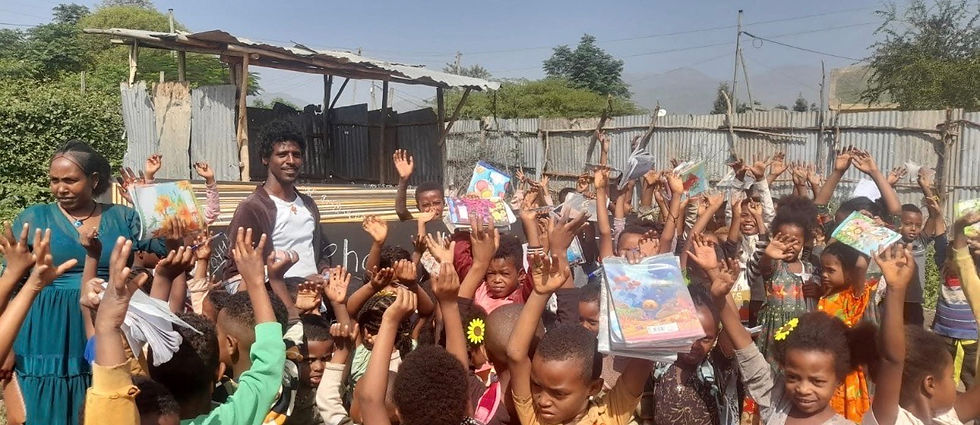
I also traveled to Lalibela with a friend. We visited the rock hewn churches Bete Medhanalem, Bete Maryam, and Bete Aba Libanos for the first time, hiked Mount Hudad with children from a nearby village, and walked alongside packs of wild Gelada baboons. In the evenings, we drank tej with locals and ate beans with farmers. My friend, Tsedi fell in love with the countryside accent in a way I could not fully catch with my limited Amharic.
I continued my solo travels to Europe, carrying the same openness and curiosity. In Berlin, a chance encounter planted a seed for the business I’m currently building, and that story deserves its own dedicated piece, so I’ll share it soon.
If I had followed the conventional timeline, I would have missed experiences that could never be repeated, especially my final time with my last living grandparent. In 2020, just a month after I returned to the United States, Covid19 shut down travel worldwide. Later in the same year, the war in Tigray cut off access to the entire region destroying hundreds of thousands of lives and decades of infrastructure and social progress.
Even though I worked hard for those experiences, I also recognize that the ability to earn money and travel is a significant privilege. In Ethiopia, that contrast followed me like a shadow. Many well educated and hardworking people I met who were raised in Addis Ababa had never been to Tigray or visited UNESCO sites in their own country that foreigners travel across oceans to see. Not for lack of interest, but mainly because it is often unaffordable.
When people cannot visit a place, gaps get filled with stereotypes, mythology, and secondhand history. Some refer to Tigray as a tribe, a monolith, rather than a region with diverse subcultures and ethnic groups with multiple languages. Tigrigna dialects are so distinct that even native speakers struggle to understand each other across distance. Variations in local dialect can be so striking that someone from Adwa and someone from Raya likely struggle to understand each other beyond the basics.
The gap between a nation on paper and the lived reality of ties between people shaped by nuanced identities, cultures, and languages has consequences. I did not fully grasp the weight of the disconnect until the war in Tigray in 2020, when access became existential for my family and the millions who were was cut off from the rest of the world.
What I saw in Ethiopia is not an isolated story. It reflects a wider pattern across Africa, where barriers to movement limit connection, understanding, and opportunity. The world’s most integral growing workforce is rising in Africa, inside a continent where many Africans still cannot easily move across borders, or even within their own countries. Visa rules, high costs, and indirect routes can make neighboring countries feel farther away than Europe. In only 28% of country to country travel scenarios within Africa, African citizens do not need a visa and only 19% of intra Africa routes have direct flights.
Travel is not a luxury in that context. It is infrastructure for empathy. It is how we replace assumptions with relationships, how we understand each other beyond propaganda, and how we make meaning of where we come from and where we are going.
This matters because Africa is not peripheral to the future of work, it is central. The United Nations Economic Commission for Africa projects Africa’s working age population will rise from 883 million in 2024 to 1.6 billion in 2050, constituting 25% of the global working age population. The World Bank similarly notes that Sub Saharan Africa’s population is set to grow from 1.5 billion in 2024 to 2.5 billion by 2050, with about 1 in 3 people ages 15 to 34 globally will be African. The International Labour Organization states that between 2023 and 2050, the youth labor force in sub Saharan Africa is expected to grow by 72.6 million, while youth labor forces in ageing countries are shrinking.
None of this is abstract. It indicates the next and largest generation of builders, creators, and leaders will increasingly be African. Access will shape whether we meet each other with real understanding or from a distance. When people can move, meet, and witness each other’s realities it becomes easier to build connection and find peace within ourselves and with each other.


If you were wondering... my dream of seeing Ms. Hill perform live (and meeting her) came true, twice!
My journey revealed access is part of what makes purpose possible. May your path lead you to what your heart dreams of. Tomorrow is not promised and life is not fair, so do what you can while you can.


Comments