Social Innovation In Focus
- Abigail Teka
- Mar 2
- 5 min read
Business Frameworks for Systems Change
According to the World Economic Forum, social enterprises are fueling a quiet revolution. “There are an estimated 10 million social enterprises worldwide, creating nearly 200 million jobs and generating $2 trillion in revenue each year – more than the global fashion industry. Africa alone has over two million social enterprises, accounting for 12 million jobs and approximately 3.2% of the entire continent’s GDP.”
If I had to envision an ideal society and identify its merits, one of my assumptions is that its economy functions more like an ecosystem and less like capitalism. Its governing institutions would reflect the sophistication of nature’s feedback loops. The means of production, distribution, and consumption would reflect a reciprocal relationship akin to photosynthesis, rather than extraction or depletion.
By contrast, in the U.S., neoliberalism has been the dominant economic philosophy since the late 20th century, shaping how economic power is exercised and defended. It treats market based solutions as the most efficient way to organize economic life, advocates for privatization and deregulation, and narrows the role of the state in favor of private enterprise. Within this framework, commerce, competition, and entrepreneurship are positioned as key drivers of economic growth and social wellbeing.
This worldview is further legitimized by free market capitalism by way of meritocracy, the belief that hard work and talent reliably produce success. The story is motivating because it frames opportunity and upward mobility as broadly accessible, even when real outcomes are heavily shaped by unequal access to capital, ascribed status, and networks.
One of the philosophical critiques of capitalism is that monopolies are a tendency within it. Critics argue that unregulated or weakly regulated free markets naturally trend toward concentration over time, meaning monopoly power is not an accident but an outcome of how capital accumulates and leverages.
As capital concentrates, competitiveness shifts from building the best solution to securing access to the gatekeepers who control resources. In practice, what gets supported often depends on what fits dominant models of risk and return, and that shapes which missions receive capital.
Several years ago, I worked in a startup and I witnessed firsthand the specific barriers to accessing the resources needed to build a company at scale. I learned how many hoops founders must jump through to secure funding from high net worth individuals and entities. Once capital is raised, founders become financially and legally accountable to investors, expected to report out regularly, and subject to their influence over major business decisions like hiring to how a product or service is presented. Raising capital can become a second full time job, with hidden costs that show up long after the check clears.
The founder investor relationship can become a pressure cooker environment, where dialogue about risk crowds out creativity, collaboration, and purpose. Investors understandably want to protect their capital and earn returns, but values shape what gets labeled as risk in the first place.
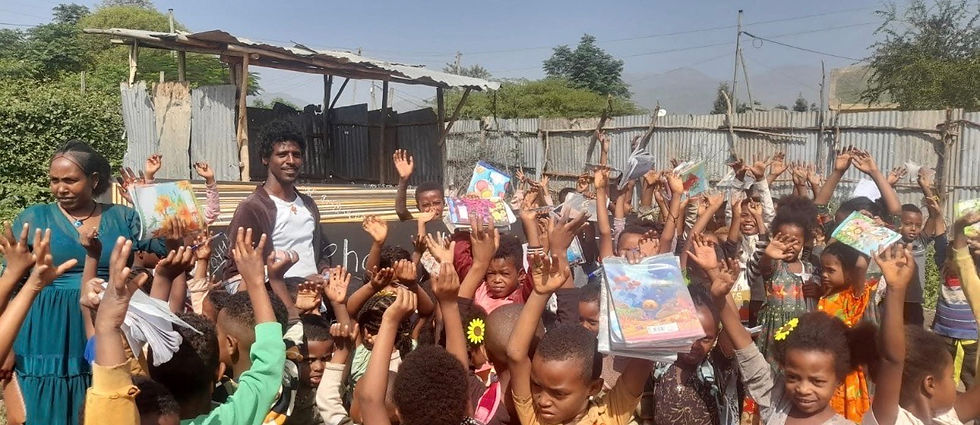
Mekhoni Hair is a budding social enterprise with the purpose of preserving the ancient hair care traditions of Raya Azebo, bring them to a global market safely, and reinvest in the indigenous communities the company represents. During my first impact project, my team fulfilled the needs assessments for school supplies across 5 schools in Mekhoni and saw how fulfilling it can be when business is designed as a utilitarian vehicle for social change. For me, the greatest risk is failing to preserve the ancient heritage, traditions, and knowledge that still exist.
Mekhoni is my middle name, given by my father after the town where he was born and raised. My family has lived there for many generations, and it is widely regarded as the heart of Raya and a source of pride across Tigray and Ethiopia at large. So, while my work is deeply personal and rooted in my heritage, it also carries an emic responsibility to represent hair culture, wellness, and beauty traditions as our community understands them, and an etic responsibility to interpret and communicate them through broader frameworks to the world without reducing their meaning or complexity.
My goal is to enable cultural exchange without exploitation and support the agency of the indigenous communities who have stewarded this culture for centuries. That risk outweighs every other concern, including the pressure to optimize for profit.
Recently I spoke with a friend who is a lecturer at Aksum University in Tigray whose career is in cultural preservation. We discussed cultural diffusion and he explained how the impact of globalization is inevitable and, in some ways, diluting traditional culture from within. At the same time, a depleted economy offers no stable jobs, creating a different kind of pressure on the youth.
When the pathways that once signaled success, like becoming doctors or lawyers, no longer seem viable, many gravitate toward what feels accessible and immediate, like becoming “TikTokers” in hopes of monetizing. Globalization accelerates that shift by reshaping what is admired, rewarded, and seen as possible, moving the definition of success toward visibility and perceived mobility. In that way, cultural shift, economic hardship, and changing ideas of value reinforce each other, and loss can accelerate quickly.
What is undeniable is that the old world order is shedding. Geopolitics are intensely volatile and assumptions about currency, stability, and the notions of value that we took for granted are being renegotiated in real time. When institutions, technologies, and geopolitics shift, so do the incentives that shape what gets built, what gets preserved, and who benefits.
When change accelerates on a global scale, narrow definitions of value create blind spots that become expensive to humanity.
What is success? Success is subjective and is determined by one’s values. It can mean solving a market problem and maximizing profits for shareholders over time. It can also mean building durable systems that protect communities, regenerate resources, and create impact that lasts.
We are at a critical juncture where the definitions we reward will shape what gets built, what gets preserved, and who benefits. If we are designing systems, we have to be honest about what our current systems reward, and what they ignore.
Entrepreneurs help build what comes next.
Typically, entrepreneurs focus on solving a market problem, while social entrepreneurs prioritize solving a social problem. While both are innovative and business minded, social entrepreneurs use business as a tool for systemic change. This requires business frameworks and impact metrics that treat preservation as value, not as a cost.
As a social entrepreneur, I believe in contributing to the world of social enterprise and social business because it is one of the most pragmatic bridges between today’s incentives and tomorrow’s needs.
If the World Economic Forum recognizes that social enterprises can operate successfully at scale, then the question is not whether they belong in our global economy, it is whether our capital systems will evolve enough to recognize their full value.


Comments